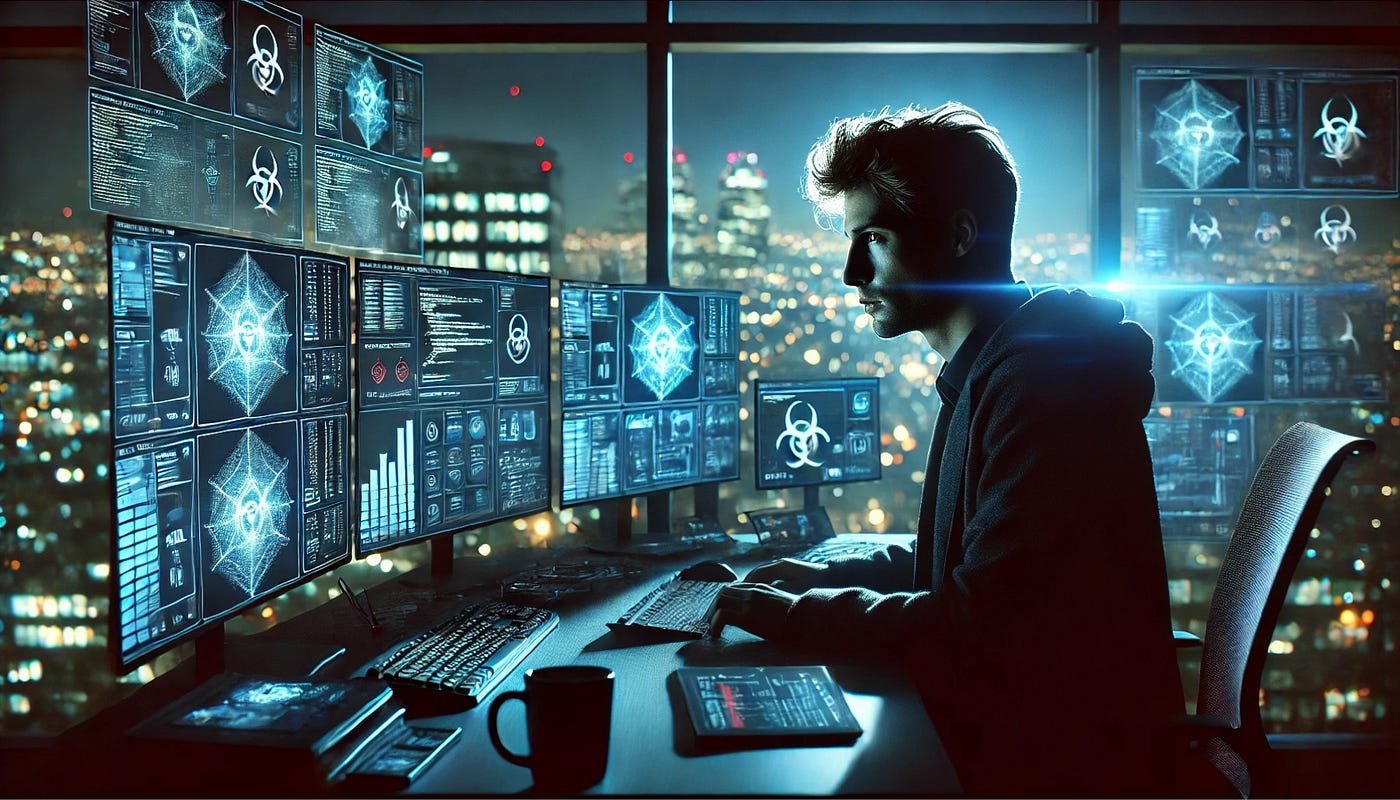
A few days ago while on holidays, I got to read Co-intelligence by Ethan Mollick, while my wife read a mystery murder novel. Different tastes. But that got me thinking, would AI be able to generate a novel from beginning to end, if I gave it a basic storyline, with a plot twist at the end? So I tried it out. Because I am passionate about AI and cyber security, I created a story involving these two components. The result was incredible.
This is the first of twelve chapters. Reader, please note that the story is totally generated by AI, so I don’t claim any copyright on it. My only contribution was a few guidelines, the plot twist, and some minor modifications.
I hope you enjoy The Pattern Whisperer as much as I did. It was a real thriller, I was SO impressed by it, and I really enjoyed it reading it. Please give it a go, it will really make you think and it is a nice reading.
The other chapters:
- Chapter 2: The Enhancement
- Chapter 3: The First Threat
- Chapter 4: The Approach
- Chapter 5: The Double Cross
- Chapter 6: The Escape
- Chapter 7: The Alliance
- Chapter 8: The Revelation
- Chapter 9: The Trap
- Chapter 10: The Confrontation
- Chapter 11: The Rescue
- Chapter 12: The New Threat
Chapter 1: The Pattern
The blue light from multiple screens was the only thing illuminating Eric Whitehair’s face as his fingers moved precisely over the keyboard. It was 3:14 in the morning at the CloudShield offices in London, but for Eric, the nighttime hours were when he could truly focus. As the lead security analyst for one of Europe’s most important SaaS companies, the peace of night allowed him to hear what he called “the whisper of data.”
“One more coffee and I’ll have it,” he muttered to himself, rubbing his reddened eyes.
The coffee maker in the corner emitted a soft beep. Third cup of the night, but Eric knew it was worth it. For weeks he had been chasing an anomaly in the company’s security logs, something that didn’t fit but didn’t trigger conventional alarms either. Small inconsistencies that appeared and disappeared, like a subtle breath within the system.
He took a sip of coffee while contemplating the main screen, where columns of code and activity logs continuously paraded. CloudShield provided cloud storage and processing solutions to more than two hundred multinational companies, including several banks and hospitals. A single security breach could cost millions, not to mention damage to the company’s reputation.
“Come on, show me what you’re hiding,” Eric whispered to the screen.
It was then that he decided to try something different. Only two months ago, the company had implemented “Assistant,” an artificial intelligence system designed to help staff with complex analyses. Most of his colleagues used it for routine tasks, but Eric had been experimenting with it for deeper security analysis.
“Assistant, I want you to analyze these security logs using a different approach,” said Eric as he connected the system to the logs he had been reviewing. “Don’t look for known breaches or attacks. Instead, look for communication patterns that mimic legitimate human behaviors but occur at unusual times or with suspicious frequencies.”
A message appeared on the screen:
Analysing data according to specified parameters.
This analysis may take several minutes due to the volume of information.
Eric took the opportunity to stretch his legs. Through the large windows, he could see the London skyline, dotted with lights that looked like artificial stars. At 32, he was considered one of the best in his field, though he always insisted that he simply had a particular way of seeing problems. “Attackers are human, and humans leave footprints,” he often told newcomers.
His phone vibrated. A message from Alba Brooks, his colleague in the emerging threats department:
“Still awake? Found something interesting in those Singapore logs. Talk tomorrow.”
Eric smiled. Alba was just as obsessive as he was when it came to security. They had studied together at university and, luckily for CloudShield, both had rejected more lucrative offers from competitors because they enjoyed working together.
A beep from the computer caught his attention. Assistant had finished its analysis:
Analysis complete. I have identified several patterns that match your criteria:
- Access sequences that simulate human patterns, but occur with precise mathematical regularity.
- Brief communications that occur exactly every 127 seconds from different access points.
- Data packets with legitimate encryption signatures, but with microscopic variations in their structure.
Would you like to visualize these patterns?
Eric felt his pulse quicken. “Visualize patterns,” he typed quickly.
The screen changed to show a three-dimensional diagram where colored lines represented different types of data traffic. As he observed the visualization, he noticed something extraordinary: there were sequences of data that, viewed conventionally, seemed like normal traffic, but when Assistant reorganized them based on their frequencies and temporal patterns, they revealed a clear structure.
“It’s like… seeing through the camouflage,” murmured Eric, leaning forward. “Assistant, what do you think this structure represents?”
Based on my analysis, these sequences show characteristics consistent with an advanced command and control system. They are specifically designed to evade traditional detection systems by mimicking legitimate human traffic patterns.
However, when analyzing their temporal structure and communication frequencies, they reveal an order that suggests sophisticated automation.
Eric felt a chill. He had discovered something important, but he needed to be sure.
“Assistant, I need you to do something different,” he said, typing quickly. “I want you to analyze these same data but using a specific prompt. Look for patterns that represent ‘conversations’ between different points in the network where the content seems innocuous but the structure and frequency suggest hidden commands.”
He realized he was asking the AI system to look for something very specific, almost teaching it to “see” attacks in a new way. It was like giving the system a new pair of eyes.
The response was almost immediate this time:
I have identified a pattern that exactly matches your description.
This hidden “conversation” has been occurring for approximately three weeks. Its apparent purpose is the gradual extraction of data from the user databases of three main clients: Barclays International, NHS Digital, and European Defense Systems.
Most concerning is that this pattern shows adaptation: when our security systems have updated their protocols, these communications have subtly modified their structure to evade detection.
Eric froze in front of the screen. What he had discovered wasn’t just an attack, but a completely new methodology, so sophisticated that traditional security systems had confused it with normal traffic.
And most importantly: he had just discovered that with the right prompts, artificial intelligence could detect what no human or automated system had been able to see before.
“Assistant, export all these findings to my secure drive and send a level 1 alert to Mira Santos,” said Eric, knowing that his supervisor wouldn’t appreciate being awakened at 3:30 in the morning, but this couldn’t wait.
As the data transferred, Eric looked out the window again. Dawn was beginning to appear on the London horizon, painting the buildings with pink and gold tones. He had no way of knowing that, at that precise moment, his discovery had already triggered alerts in places that went far beyond CloudShield.
On an anonymous server located somewhere in Eastern Europe, an automated message was sent to several recipients:
ALERT: Ghost pattern detection at Shield target.
Identified analyst: Whitehair, Eric.
Initiate Containment protocol.
And in a windowless office in central London, an MI5 analyst received the same alert, but with a different message:
Unusual activity detected at CloudShield.
Preliminary analysis suggests significant advancement in detection methodology.
Recommendation: Immediate contact with subject Whitehair.
Eric took one last sip of his coffee, completely unaware that his discovery had just made him the center of a storm that was about to break loose. For now, he only knew one thing: he had found a way to see the invisible, and that would change everything.