Start here: Chapter 1: The Pattern
The Sentinel system emitted a silent alert at 3:42 in the morning. Eric, who was dozing on the sofa in the server room with a thermal blanket covering him up to his neck, woke up instantly when his phone vibrated. He had configured the alerts to wake him only if Sentinel detected a critical-level attack.
“Damn it,” he muttered as he sat up, rubbing his eyes to clear them.
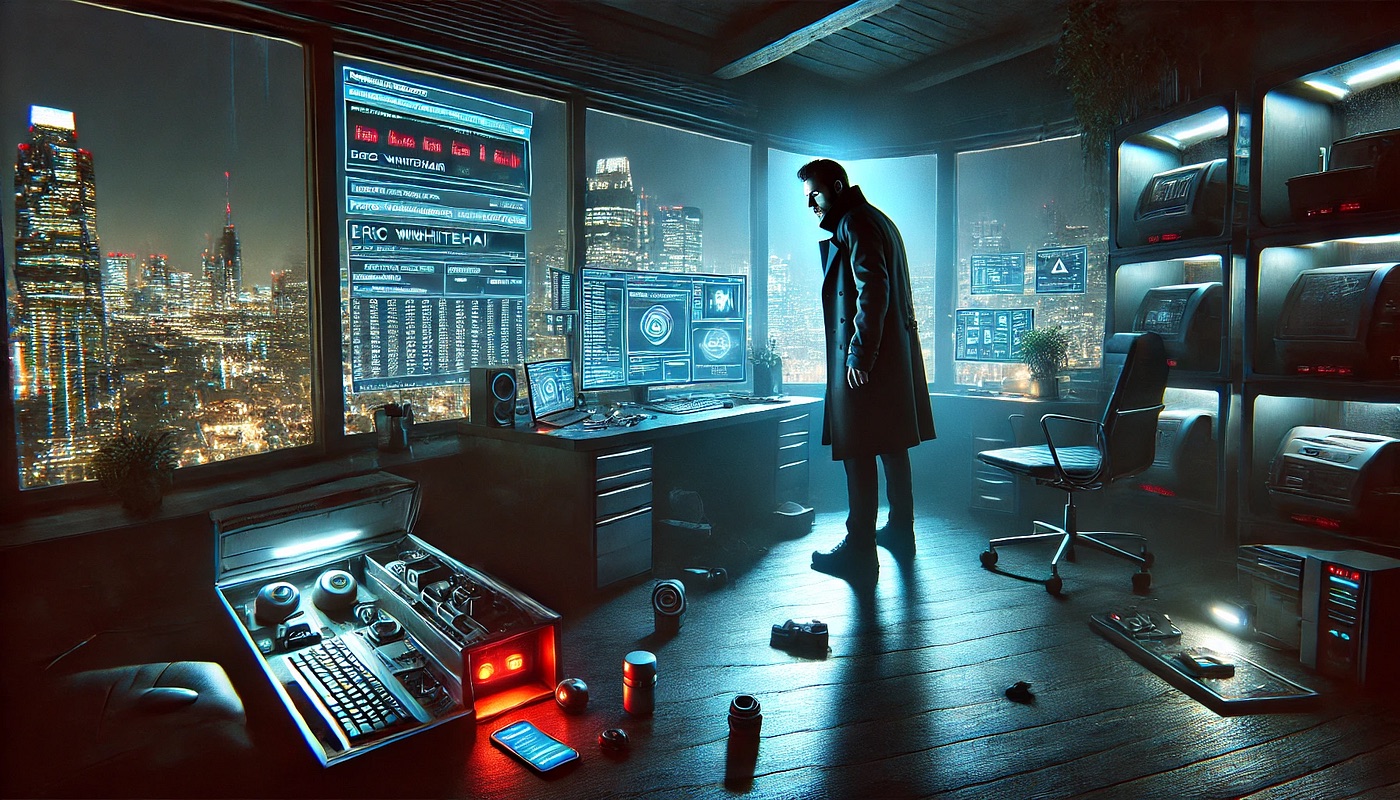
The main screen displayed a connection map flashing in intense red. It was the visual representation that Eric had designed for the most sophisticated attacks: a neural tree of connections where each branch represented a different intrusion vector.
He approached his workstation and began analyzing the data. It took him only a few seconds to understand the gravity of the situation.
“It’s a coordinated attack on the central servers,” he murmured to himself, as his fingers flew over the keyboard. “And it’s elegant, I have to admit.”
What Sentinel had detected was a multifaceted attack directed at the servers that stored the banking information of one of their most important clients. What made this attack particularly dangerous was its ability to reorient itself: if one pathway was blocked, it automatically redirected its resources to another.
Since Sentinel’s implementation four days ago, they had detected and neutralized several intrusion attempts, but none with this level of sophistication. This wasn’t an opportunistic attack; someone had carefully studied their defenses and designed a specific plan to evade them.
“Sentinel, show me the origin of the attack,” Eric ordered.
A world map appeared on the screen with dozens of luminous points distributed across the globe. It was a network of zombie computers, remotely controlled to hide the true origin of the attack.
Eric smiled despite the severity of the situation. This was exactly the kind of challenge for which he had created Sentinel.
“Sentinel, activate the reverse tracking lens. Look for temporal patterns in the initiation of connections.”
The visualization changed, transforming into a chronological sequence. The attack points no longer appeared simultaneous, but as a cascade that began in a specific region.
“Got you,” murmured Eric. “Eastern Europe, probably… wait.”
A new alert appeared on the screen. Someone was trying to directly access Sentinel at that very moment.
Eric felt his heart rate accelerate. This wasn’t a coincidence; the attack on the servers was just a distraction. The real target was Sentinel.
He quickly activated the isolation protocols that he had implemented with Alba. The system automatically disconnected from the corporate network, remaining operational but inaccessible from the outside.
“Sentinel, show me the last queries made before isolation.”
Lines of code appeared on the screen that made Eric hold his breath. Someone had been trying to extract Sentinel’s fundamental algorithms, the “detection lenses” that made it possible to identify invisible attacks.
With trembling fingers, he activated a general alert for the security team and took his phone to call Alba directly. It was almost four in the morning, but this couldn’t wait.
“Alba, it’s Eric,” he said as soon as she answered, her voice still thick with sleep. “We have a serious problem. Someone just tried to steal Sentinel.”
“What?” Alba’s voice now sounded fully awake. “How is that possible? We implemented…”
“I know, I know,” he interrupted her. “Our measures worked, the system is isolated. But this was coordinated, Alba. A massive attack on the banking servers as a distraction while they tried to access Sentinel. Whoever is behind this knows exactly what we’re doing.”
There was a brief silence on the other end of the line.
“I’m on my way,” she finally said. “Don’t do anything until I get there. And Eric… be careful.”
The call ended, leaving Eric alone in the dimly lit room, illuminated only by the bluish glow of the screens. While waiting for Alba, he continued analyzing the attack, tracing its origin through the tangle of fake connections.
Sentinel had automatically neutralized the threat to the banking servers, redirecting malicious traffic to decoy servers and sealing the vulnerabilities that the attacker had tried to exploit. It was impressive to see the system in action, executing countermeasures that would have taken hours for a human team.
But what worried Eric most was that someone had specifically tried to access Sentinel’s core algorithms. That meant information about its exact nature had leaked.
When Alba arrived forty minutes later, with her hair hastily tied back and pronounced dark circles under her eyes, Eric had already prepared a complete report of the incident.
“This is worse than I thought,” said Alba after reviewing the data. “The attack wasn’t just sophisticated, it was… personalized. Specifically designed for our defenses.”
Eric nodded gravely.
“And there’s more,” he said, showing her another screen. “I’ve traced the real origin of the attack. The zombies were just a smoke screen. The source comes from a server in Prague, but the interesting thing is this…”
He pointed to a series of IP addresses that had briefly interacted with the Prague server just before the attack.
“These addresses belong to CloudShield’s internal network. Someone from inside was coordinating with the attackers.”
Alba paled.
“A mole? Are you sure?”
“Not one hundred percent, but it’s the most likely explanation. Someone with internal access has been leaking information about Sentinel and coordinating with external attackers.”
They looked at each other in silence, processing the implications. Trust was the most valuable asset in cybersecurity, and they had just discovered they couldn’t trust even their own organization.
“We have to inform Mira,” Alba finally said.
“I will, but not by email or phone. We don’t know to what extent our communication is compromised.”
At that moment, Eric’s phone received a text message. The number appeared as “Unknown.”
“Impressive defense, Mr. Whitehair. Sentinel is even more capable than we expected. But remember: every system has its weak point. Yours just revealed its own: you yourself. Enjoy your apartment while you can.”
Eric felt a chill run down his spine. The message not only confirmed that someone was specifically targeting Sentinel, but it also contained a barely veiled personal threat.
“Look at this,” he said, passing the phone to Alba.
She read the message, her face reflecting the same concern Eric felt.
“This is no longer just a cyber attack, Eric. It’s a direct threat.”
“I know.”
“You shouldn’t go home today,” continued Alba. “If they know where you live…”
“I’m not going to hide,” Eric interrupted her. “Besides, I need to check if my apartment is secure. I have backups of Sentinel there, on a local server. If they’ve compromised my home…”
He didn’t need to finish the sentence. They both knew what was at stake.
“I’ll go with you,” Alba said firmly.
“No, it’s better if we separate. You go talk to Mira in person, explain the situation. I’ll go to my apartment, retrieve the backups, and meet with you both afterward.”
Alba seemed to want to protest, but finally nodded.
“Be careful,” she said, briefly squeezing his arm. “And keep your phone on.”
Eric’s apartment was located in a modernist building in Shoreditch, a neighborhood in East London known for its artistic and technological atmosphere. During the taxi ride, he kept looking out the window, looking for signs that he was being followed. Paranoia was beginning to settle in his mind, transforming each pedestrian into a potential watcher, each car into a potential threat.
When the taxi stopped in front of his building, Eric paid in cash and waited until the vehicle drove away before approaching the entrance. The night doorman, an elderly man named Gerald, greeted him with his usual familiarity.
“Working late again, Mr. Whitehair?” he asked with an affable smile.
“Something like that, Gerald,” replied Eric, trying to maintain a casual tone. “Has there been anything unusual tonight? Visitors, deliveries…?”
Gerald frowned thoughtfully.
“Now that you mention it, there was a technician a few hours ago. He said he was coming to check the internet connection. I told him it was a bit late for that, but he had identification and everything. Very polite, too.”
Eric felt his stomach tighten.
“You allowed him into my apartment?”
Gerald’s expression changed to one of concern.
“Yes, sir. Is there a problem? He showed a work order and…”
“It’s not your fault, Gerald,” Eric reassured him. “Do you remember what he looked like?”
“Tall, thin, short blond hair. He wore glasses. Very professional in appearance.”
Eric nodded, thanking him for the information as he headed for the elevator. His mind was working at full speed, evaluating possibilities. If someone had entered his apartment, they had likely installed some kind of malware on his personal devices, or even physical spying devices.
When the elevator doors closed, he took out his phone and sent an encrypted message to Alba: “Uninvited visitor confirmed. Proceeding with caution.” Then he turned off the phone completely, even removing the battery.
Upon reaching his floor, Eric stopped in front of his door. There were no obvious signs of tampering with the lock, but that meant nothing to a professional. He took a deep breath and opened the door with his key.
The apartment was exactly as he had left it, apparently. The living room with its black leather sofa, the open kitchen with dishes still unwashed, his workstation in the corner by the window. Everything seemed normal, and that was precisely what worried him.
He closed the door and stood still, listening. The silence was total, interrupted only by the almost imperceptible hum of the refrigerator. With deliberately slow movements, Eric headed for his workstation. He didn’t turn on any devices; instead, he began looking for physical signs of tampering.
It didn’t take him long to find them. His main computer had been opened and closed again with precision, but Eric knew every millimeter of his equipment and could detect the subtle marks. He also found a small device attached under his desk, no bigger than a coin: a high-sensitivity microphone.
With growing alarm, he continued his methodical inspection of the apartment. In total he found three microphones, a small hidden camera in the ceiling lamp, and evidence that all his devices had been compromised.
The local server where he kept Sentinel’s backups was hidden inside what appeared to be an old stereo system, a trick that Eric had implemented precisely for situations like this. Carefully, he checked the imperceptible seals he had placed on the cover. They were intact, which meant the intruder hadn’t discovered his hiding place.
With quick and silent movements, he extracted the hard drives from the server and stored them in the inner pocket of his jacket. Then, he made a decision. If his apartment was compromised, he couldn’t stay there. He needed a safe place to analyze what they had done to his systems and determine how much information they had been able to obtain.
He was about to leave when his desktop computer turned on by itself. A message appeared on the screen:
“Good choice recovering the disks, Mr. Whitehair. Unfortunately, we already have what we needed. Sentinel is now ours too. Abandon the project if you value your life. This is your only warning.”
Eric felt a chill run down his back. The message confirmed his worst fears: someone had not only accessed his apartment but was monitoring him in real-time.
Without wasting any more time, he quickly left the apartment. Instead of taking the elevator, he used the emergency stairs, descending the five floors at full speed. Upon reaching the ground floor, he avoided the main lobby and exited through a side door that led to an alley.
The London night greeted him with a cold drizzle. Eric turned up his jacket collar and began walking quickly, blending in with the few pedestrians wandering at that hour. He needed to find a safe place and contact Alba, but he couldn’t use his phone or credit cards if he wanted to avoid being tracked.
After walking for twenty minutes, frequently changing direction to detect possible followers, Eric entered a 24-hour café. The place was almost empty except for a couple of students with laptops and a middle-aged man reading a newspaper. Eric ordered a coffee and sat in a corner, trying to organize his thoughts.
The situation was clear: someone had discovered Sentinel and wanted to take over the technology. They had compromised his apartment, his personal devices, and were probably monitoring his movements. Worse still, the message suggested they had already obtained significant information about Sentinel.
Eric took a napkin and a pen he carried in his pocket. In tiny handwriting, he began to list his options. He needed to contact Alba without being detected, regain control of Sentinel, and identify the infiltrator at CloudShield.
His biggest concern was that the attacker had obtained access to Sentinel’s core algorithms. If that had happened, they could use the technology for their own purposes, or worse, modify it to make it ineffective against their own attacks.
After finishing his coffee, Eric headed to a small, anonymous hotel several streets away. He paid for one night in cash, using a false name, and went up to the room. It wasn’t the safest place, but it would give him time to plan his next move.
Once in the room, he extracted one of the hard drives from his jacket and connected it to the laptop he had bought at an electronics store on his way to the hotel. It was a basic device, but sufficient for his immediate needs.
The disk contained encrypted copies of Sentinel’s essential components. Eric spent the next few hours meticulously reviewing each file, looking for evidence of what information the intruders might have obtained. What he discovered left him deeply concerned: although they hadn’t gotten the complete algorithms, they had obtained enough fragments to potentially reconstruct critical parts of the system.
Near dawn, Eric finally allowed himself a brief rest. He lay down on the bed without undressing, his mind still frantically working on possible solutions. He needed to contact Alba, but every conventional method of communication represented a risk.
It was then that he remembered an emergency protocol they had established months ago, almost like a game: an anonymous account on a chess forum, where they could leave coded messages as game analyses. It was rudimentary, but possibly still secure.
Using the Tor network to hide his IP address, Eric accessed the forum and published an analysis of a nonexistent game, encoding in the notation a message for Alba: “Apartment compromised. Sentinel partially exposed. Will remain hidden. Meet me at our contingency location at 14:00. Trust no one.”
After sending the message, Eric turned off the computer and approached the window. The London sky was beginning to clear, a new day was being born. But for Eric, the world had transformed into a much darker and more dangerous place than it had been just 24 hours before.
His discovery, which had begun as a brilliant innovation in cybersecurity, had now made him a target. And the worst part was that he still didn’t know who was after him: a criminal organization? a rival government agency? corporate competitors?
The only thing he knew with certainty was that he couldn’t trust anyone, except perhaps Alba. And that the meeting with MI5 scheduled for that day was no longer simply an official visit, but potentially part of a much larger conspiracy.
With these turbulent thoughts, Eric prepared for a few hours of restless sleep. The battle for Sentinel had just begun, and he was at the center of the storm.
Next: Chapter 4: The Approach