Start here: Chapter 1: The Pattern
The afternoon sun filtered through the blinds of the conference room while Eric Whitehair organized his notes for the third time. Barely twelve hours had passed since his discovery, but he had already slept for four hours, taken a cold shower, and consumed more coffee than any doctor would consider healthy. His body operated on a mixture of adrenaline and caffeine that made his eyes shine with unusual intensity.
“So, you’re telling me you’ve found a way to make AI see attacks that our systems can’t detect?” asked Mira Santos, leaning back in her chair while fidgeting with a pen between her fingers.
Mira, CloudShield’s security director, was known for her methodical skepticism. With more than fifteen years in the sector and a doctorate in cryptography, she wasn’t easily impressed. However, Eric noticed a flash of genuine interest in her dark eyes.
“Not exactly,” replied Eric, projecting the graphics he had prepared onto the main screen. “What I’ve discovered is that we can teach Assistant to recognize patterns that are invisible to traditional systems. It’s like… like teaching it to see ghosts.”
Alba Brooks, seated on the other side of the table, raised an eyebrow.
“Ghosts? Quite a metaphor for someone whose last name literally means ‘white hair,’” she joked, although her face reflected concentration as she studied the data. “But I understand what you mean. It’s impressive.”
Eric projected a series of three-dimensional visualizations showing the attack he had detected the night before.
“These are the raw data that our systems classified as normal traffic,” he explained, pointing to the first image. “And this,” he continued, switching to the next visualization, “is what Assistant was able to see after I gave it the right instructions. The contrast is… well, you can see for yourselves.”
The difference was astonishing. Where before only random traffic patterns were visible, now a clear structure emerged: a complex communication system specifically designed to evade detection.
“What kind of prompts did you use exactly?” asked Mira, leaning forward with interest.
Eric smiled. This was the part that excited him the most.
“That’s the crux of the matter. I’ve been refining the prompts all morning and created what I call a ‘detection lens.’ Basically, they’re series of instructions that teach the AI to recognize certain anomalous behaviors that camouflage themselves as normal.”
He projected on the screen a document containing several carefully crafted sets of instructions.
“For example, this set of prompts teaches Assistant to identify what I’ve termed ‘digital respirations,’” he pointed to the first section. “They’re ultra-brief communications that occur at regular but variable intervals, as if the attacking system were… breathing.”
Mira adjusted her glasses, studying the text carefully.
“This is fascinating, Eric, but have you been able to replicate the results? Does it work with other data sets?”
“That’s the best part,” Alba interjected, sliding a tablet toward Mira. “Eric sent me his prompts this morning, and I tested them with the Singapore logs I mentioned last night. Look at these results.”
The tablet screen showed another visualization, similar to the first but with significant differences in structure.
“We detected a completely different attack, using the same methodology of instructions,” explained Alba. “It’s as if we’ve discovered a new spectrum of light and suddenly we can see things that have always been there but were invisible to us.”
Mira remained silent for several seconds, processing the information. Finally, she put the pen on the table and crossed her arms.
“How certain are you that these are actually attacks and not just… anomalies in the data?” she asked, although the tone of her voice suggested she was already convinced.
“One hundred percent,” Eric responded without hesitation. “This morning I executed a controlled isolation of the suspicious connections and was able to confirm they were covertly extracting data. The incident response team is already working on it. But the important thing isn’t just that we stopped these specific attacks…”
“…but that we have a new tool to detect any similar attack in the future,” completed Mira, nodding slowly. “And potentially, a completely new method for preventive cybersecurity.”
Eric nodded, satisfied that Mira understood the full implications of his discovery.
“Exactly. I’ve started creating a library of specialized prompts for different types of suspicious behaviors. Assistant is learning at an impressive speed.”
Alba projected another visualization on the main screen.
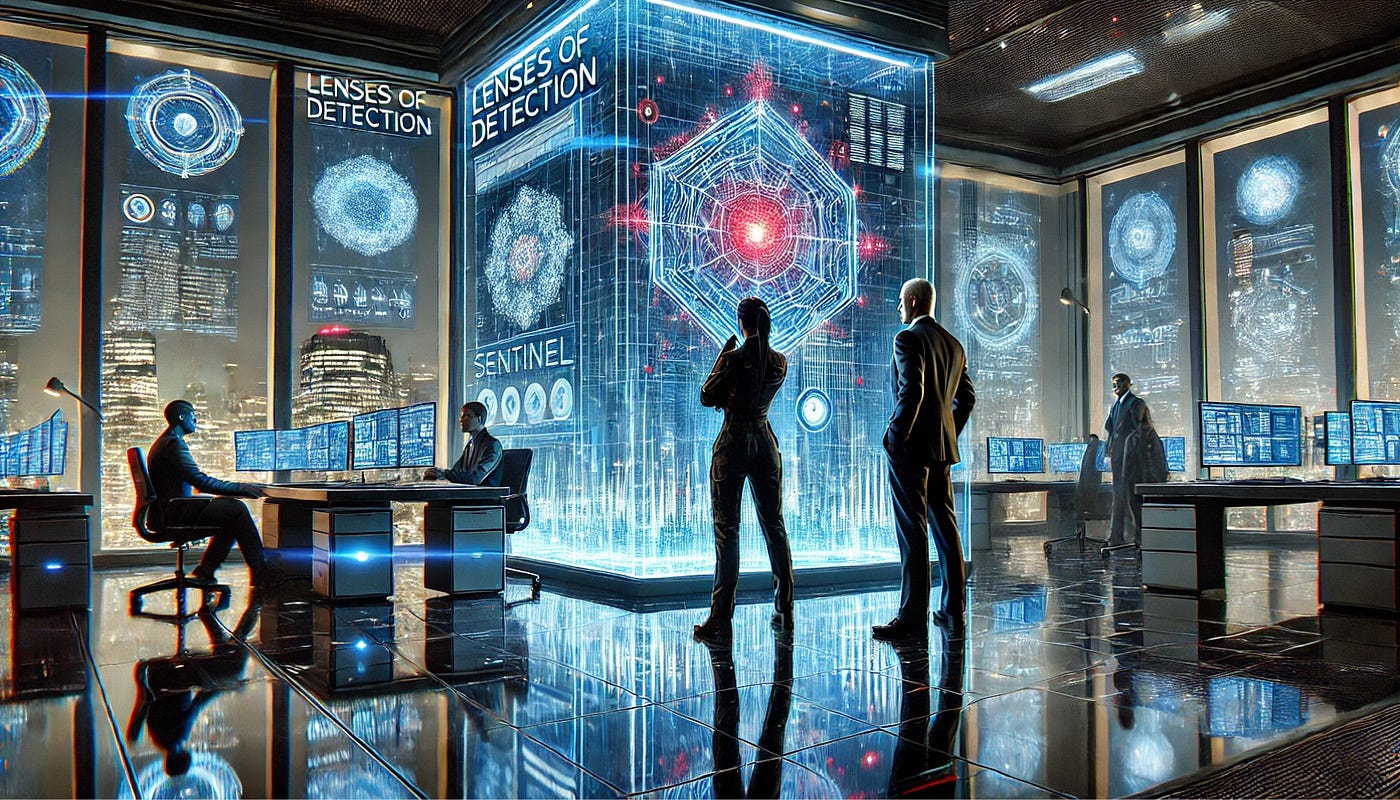
“Eric has named the system ‘Sentinel,’” she explained. “Basically, it’s Assistant but with a specialized set of detection lenses that allow it to see the invisible.”
Mira stood up and walked to the window, contemplating the London skyline while considering the implications.
“This could change the entire security paradigm,” she said finally. “Not just for CloudShield, but for the entire industry.”
She turned to Eric and Alba with a serious expression.
“We need to keep this absolutely secret for now. If this leaks, we wouldn’t just lose a huge competitive advantage, but attackers would immediately start developing countermeasures.”
Eric exchanged a glance with Alba. Both knew that keeping such a discovery secret would be extremely difficult, especially within a company with hundreds of employees.
“I propose the following,” continued Mira. “Create a small team, no more than five people including you two. You’ll have access to dedicated resources and work in an isolated environment. I want a complete capabilities report in one week, along with a gradual implementation plan.”
“That sounds perfect,” responded Eric. “I already have a couple of people in mind who would be perfect for this.”
“Good,” nodded Mira. “I will personally inform Victor. The CEO will want to know about this, but I’ll ask for absolute discretion.”
As they gathered their things to head to their new work area, Eric’s phone vibrated with a notification. It was an email from an address he didn’t recognize. He opened it out of curiosity and felt a chill as he read the brief message:
“Eyes that can see the invisible attract unwanted attention. Sentinel is no longer just yours. Stop now before it’s too late.”
Eric looked around quickly, but Mira and Alba were busy discussing logistics. He immediately deleted the email, trying to maintain his composure. How could someone know about Sentinel so soon? Not even a full day had passed since his discovery.
“Everything okay?” asked Alba, noticing his change of expression.
“Yes, just… tired,” lied Eric, forcing a smile. “It’s been a long night.”
In the hallway, on the way to their new work area, Eric felt a growing uneasiness. He couldn’t shake the feeling that he had just unleashed something beyond his control. However, the excitement about the potential of his discovery outweighed any concern.
What he didn’t know was that at that precise moment, MI5's surveillance systems had already identified and tagged the “Sentinel” project as a development of critical interest to national security. And somewhere, much further away, the leaders of BlackMesh were holding an emergency meeting to discuss how to neutralize the threat that Eric Whitehair posed to their global operations.
In the following three days, Eric and Alba worked tirelessly perfecting Sentinel. They had recruited three trusted analysts: Sophia Chen, a network behavior specialist; Marcus Okafor, a machine learning expert; and Theo Papadopoulos, a young prodigy in digital forensic analysis.
The team had transformed a rarely used server room into their operations center. The walls were now covered with screens showing different visualizations of network traffic in real-time, filtered through Sentinel’s detection lenses.
“It’s like having X-ray vision,” commented Theo as he watched the system automatically identify and isolate a series of suspicious communications in a pharmaceutical client’s network. “How did no one think of this before?”
Eric, who had been working for thirty hours straight and had only allowed himself brief naps on the corner sofa, smiled with satisfaction.
“Because we were too busy teaching AI to do things, instead of teaching it to see things,” he responded, taking another sip of his now cold coffee. “It’s a paradigm shift.”
Alba approached with a tablet in hand, her face showing signs of concern.
“Eric, can I talk to you for a moment?” she asked quietly.
They moved to a corner while the others continued working.
“I just detected something strange,” said Alba, showing him the tablet. “Sentinel has identified a pattern of access to its own source code. Someone has been trying to analyze it from within the corporate network.”
Eric felt his stomach tighten. First the threatening email, and now this.
“Can you identify the origin?”
Alba shook her head.
“It’s too sophisticated. Whoever it is, they know what they’re doing. I’ve implemented additional protection measures, but…”
She didn’t need to finish the sentence. Both knew what it meant: someone inside CloudShield was interested in Sentinel, and not in a friendly way.
“Don’t tell anyone for now,” murmured Eric. “Not even the rest of the team. Let’s set a trap to see who’s snooping around.”
Alba nodded, but before they could elaborate a plan, the door to the room opened. Victor Chang, the CEO of CloudShield, entered followed by Mira Santos. It was the first time the CEO had personally visited their operation, and his imposing presence immediately made everyone stand up.
“Mr. Whitehair,” said Victor with a smile that didn’t reach his eyes. “I’ve heard wonderful things about your project. Mira has brought me up to speed, and I must say I’m… impressed.”
Eric and Alba exchanged a quick glance. Something in Victor’s tone sounded strange.
“Thank you, sir,” replied Eric. “We’re making good progress.”
Victor walked around the room, observing the screens with clinical attention.
“More than good progress, I’d say,” he commented. “In just three days you’ve stopped five sophisticated attacks that our conventional systems didn’t even detect. The Board is… enthusiastic about the possibilities.”
He stopped in front of the main screen, where Sentinel showed a real-time visualization of CloudShield’s global security landscape.
“I’d like to discuss potential applications beyond defensive detection,” he continued, turning to Eric. “Imagine what we could achieve if we adapted this technology to identify vulnerabilities in competitors’ systems, or even for national defense. The implications are… vast.”
Eric felt a knot in his stomach. He had developed Sentinel as a protection tool, not as a weapon for corporate or governmental espionage.
“With all due respect, sir,” he interjected, “Sentinel has been specifically designed to detect and neutralize threats to our systems and those of our clients. Reorienting it toward more… offensive applications would require significant restructuring.”
Victor smiled enigmatically.
“Of course, of course. Just exploring possibilities.” He paused and looked directly at Eric. “By the way, you’ll have a visitor tomorrow. Government representatives have expressed interest in your work. Apparently, your discovery has… caught their attention.”
Eric and Alba exchanged another look, this time of barely disguised alarm.
“What kind of representatives?” asked Eric, trying to maintain a neutral tone.
“MI5,” replied Victor without beating around the bush. “Don’t worry, it’s a purely informative visit. You’ll give them a basic demonstration, nothing more. Mira will be present at all times.”
Before Eric could protest, Victor was already heading toward the door.
“Excellent work, everyone. I’m eager to see how far this project will go,” he said, and with a gesture for Mira to follow him, he left the room.
As soon as the door closed, the team gathered around Eric.
“MI5?” whispered Sophia. “How the hell did they find out so quickly?”
“Someone has leaked information,” replied Alba, looking meaningfully at Eric. “And now it seems everyone wants a piece of Sentinel.”
Eric ran a hand through his hair, feeling the weight of the situation fall on his shoulders. What had begun as an exciting discovery was quickly turning into something much more complex and potentially dangerous.
“Let’s keep working,” he said finally. “But from now on, we implement maximum security protocols. Nothing leaves this room, and we monitor every access to Sentinel. And let’s prepare for tomorrow… something tells me it will be an interesting day.”
As the team returned to work, Eric couldn’t shake the feeling of being watched. And in a way, he was right. Not only by the invisible eyes that had sent that threatening email, or by whoever was spying from within CloudShield.
In an anonymous office in central London, MI5 agent Eleanor Wright meticulously studied Eric Whitehair’s profile, preparing for their meeting the next day. And on her screen, alongside Eric’s file, was a folder labeled: “Operation Guardian – BlackMesh Neutralization.”
The game had begun, and Eric had just become a key piece in a game whose rules he still didn’t know.