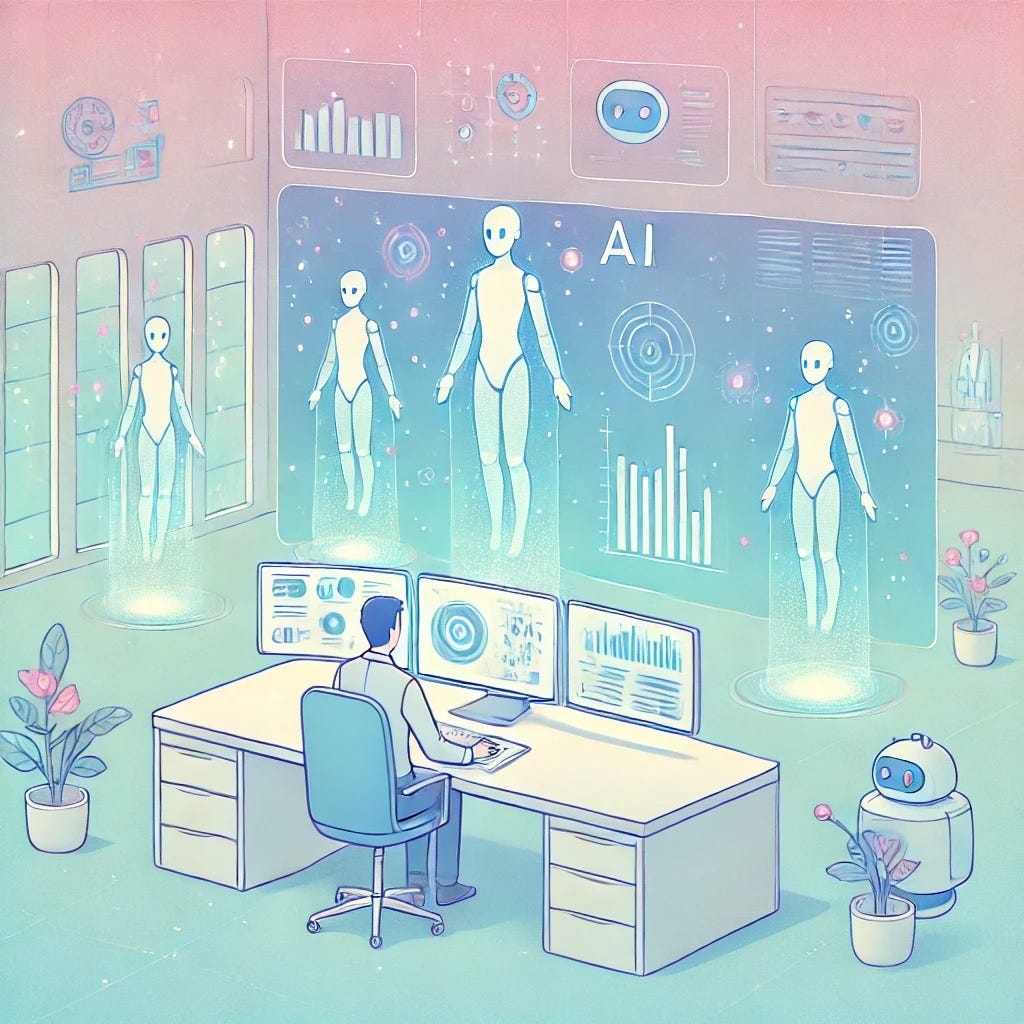
Today is 14 December 2029.
I still remember the early days of cybersecurity — hours spent poring over logs, chasing alerts, and scrambling to patch vulnerabilities in a game of perpetual catch-up. Those days feel like a distant memory now, though, thanks to the seamless integration of AI agents into our daily routines. Let me take you through one of my typical days as a CISO of a mid-sized enterprise.
Morning Briefing: Night Watch and the Early Hints of Trouble
I log in, hot chocolate in hand — I don’t drink coffee, expecting the usual morning report. An agent — I’ve affectionately named it “Night Watch” — greets me. It starts rattling off the list of alerts it handled overnight.
“Good morning,” it says in that cheerful tone I’ve grown oddly fond of. “I resolved 15 alerts from the SIEM. Seven were false positives, five were from a known benign IP range, and three were low-severity issues that I’ve already added to your dashboard for review. By the way, I noticed an unusual spike in requests to the signup endpoint — 300% above the daily average.”
I pause. “Do we have any indication of the cause?”
“Could be legitimate user growth,” it explains, “but the patterns suggest a possible mass account creation attack.”
I sip my hot chocolate, appreciating its diligence. “Let’s not take chances. Activate rate limiting — by IP and user agent — for the signup endpoint.”
“Done,” it chirps. I smile. This used to take hours of analysis and manual configuration. Now, it’s a single instruction.
Coordinating the Bigger Picture
With immediate fires under control, I turn to the larger picture. “Coordinator,” I address the agent responsible for managing projects, “what features are pending release?”
“There are three features scheduled for deployment over the next two weeks,” it replies. “Would you like me to prepare a dynamic analysis once they hit the staging environment?”
“Absolutely,” I say. “Let me know when they’re ready.”
Coordinator continues, “There are also two features in the design phase. Would you like a threat modelling session for them?”
I nod, impressed as always by its intuition. “Yes, please. Use the design documentation and Slack channels for context.”
Within minutes, the Threat Modeller agent is hard at work, parsing documents, analysing conversations, and — most importantly — asking the development team smart, pointed questions directly in Slack. It’s amusing to see the developers chatting away with an AI, almost as if it’s another team member. By midday, the agent delivers a tidy list of potential threats, complete with Jira tickets and mitigation recommendations.
No stone unturned. No delays. No ambiguity. This is what cybersecurity feels like when you’re not drowning in manual processes.
Incident Response: A New Kind of Crisis Management
Mid-afternoon, just as I’m thinking of grabbing a sandwich, an alert pops up: possible SQL injection detected on an endpoint. The agent monitoring our web application has already flagged the issue and isolated the source. Still, the stakes are too high to assume it has all the answers.
“Invoke the incident response process,” I instruct.
The agent moves swiftly, escalating to the right teams, gathering logs, and correlating data across the attack surface. It’s thorough but not infallible, so when it hits a gap in its programming, it pings me.
“Should I also block this user’s IP range?” it asks.
“Yes, but make sure it doesn’t disrupt legitimate traffic.”
This back-and-forth is quick, efficient, and — dare I say — almost enjoyable. By the time the issue is resolved, I realise something: it hasn’t consumed my day. In fact, I still have time to review our long-term strategy and prepare for a board meeting later in the week.
The New Reality of Cybersecurity
If you’d told me five years ago that I’d be working like this — partnering with AI agents to protect our systems and streamline our workflows — I’d have laughed. Now, I can’t imagine life without them.
They aren’t just tools; they’re collaborators, handling the grunt work, crunching the data, and even thinking ahead so I can focus on the bigger picture. Sure, they need guidance. They need oversight. But they also deliver insights and solutions that make my job as a CISO infinitely more effective — and dare I say it — enjoyable.
It’s a world where we’re no longer just defenders. We’re strategists, architects, and problem-solvers, supported by a tireless team of digital assistants who never sleep and never stop learning.
Now, if you’ll excuse me, Coordinator’s just pinged me. It seems the dynamic analysis is complete, and there are a few security enhancements we might want to consider. Time to dig in.
And that’s the beauty of it. The work never stops, but neither do the agents. Together, we’re shaping a new era in cybersecurity — one where we finally get to breathe.
Disclaimer: The perspectives shared here are my own and do not necessarily represent those of my employer. I use GenAI as a tool to help me compose and structure my articles.